In The Quest For More Knowledge

Ramadan with Darul Qasim

A Journey Through the Islamic Intellectual Tradition

This Ramadan, step into a tradition that spans continents and centuries.

Join the scholars of Darul Qasim as they take you across the Muslim world in Aslaf Series Part 2 — from China to India, from West Africa to Bosnia — uncovering the lives of remarkable men and women who carried the light of Islam in diverse lands, through diverse methods, yet with one unified devotion to the Qur’an and the Prophetic legacy.

Witness the beauty of our vast Islamic Intellectual Tradition — rooted in revelation, expressed through culture, scholarship, sacrifice, and service.

Ramadan Mubarak from Shaykh Amin Kholwadia
Receive a special Ramadan message from our founder as we enter this sacred month together.

Ramadan at Darul Qasim

Prayer • Programs • Community

Join Us for Tarāwīḥ Prayer

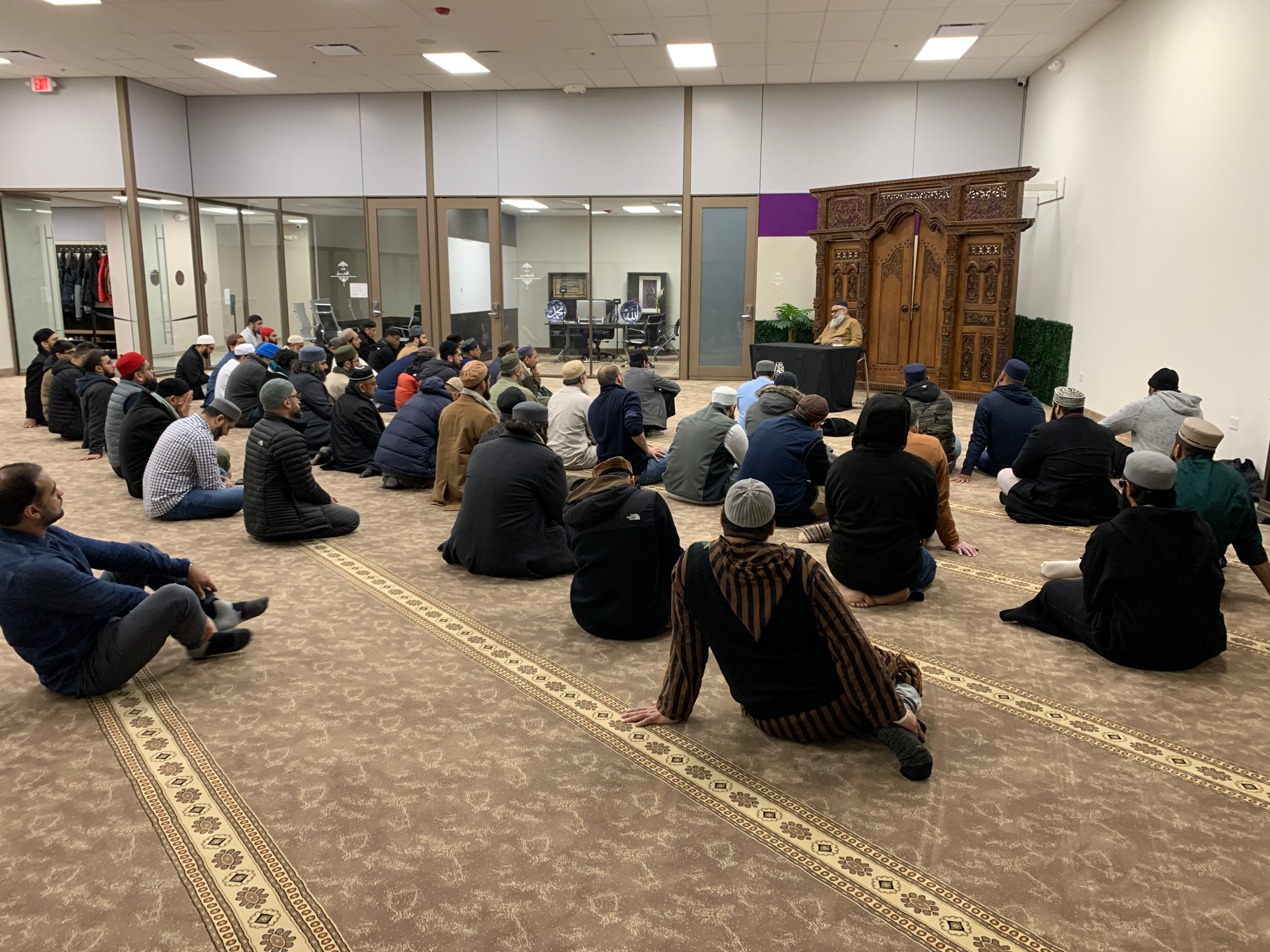
During last night’s post-khatm khatirah, Shaykh Amin asked us to prepare for duʿāʾ by looking deep into our hearts and doing two things:

1. “I want each of you to make tawbah from all of your sins.”

2. ⁠“If you want your duʿāʾ to be readily accepted, then forgive every Muslim in your heart. When you forgive others, Allah will love you and forgive you.”

This formula is not easy. It requires mujāhadah, struggling against our ego and nafs.

With these adab of duʿāʾ in mind, we share last night’s khatm duʿāʾ

Take a moment to reflect…
How did Shaykh’s two requests and duʿāʾ that followed make you feel?

Post-Tarāwīḥ Khatira

with Shaykh Amin

Spend your Ramadan nights in reflection and remembrance by joining us for a Post-Tarāwīḥ Khatira with Shaykh Amin. These short but meaningful reminders offer an opportunity to pause after prayer, reflect on the deeper meanings of our faith, and carry the spirit of Ramadan into our hearts and daily lives.

📍 Every Friday & Saturday at 9:00 PM
Darul Qasim College– Glendale Heights Location

Join us in person to benefit from the gathering of believers and the atmosphere of worship, or tune in live on our YouTube channel to follow along from wherever you are.

We invite you to make these nightly reflections part of your Ramadan routine and grow spiritually alongside our community.

Highlighted Quotes

Post Tarawih Khatira 

In this Post Tarawih khatira, Shaykh Amin discusses how to end this month strong. Listen to the short talk.

Our Aslaf Series Part 2

A Global Legacy of Faith and Scholarship

Travel through time and geography with our scholars as we explore how Islam flourished across civilizations — not as a monolith, but as a living, breathing tradition shaped by language, culture, and devotion.

From scholars in the courts of West Africa to teachers in the villages of India, from sages in Bosnia to luminaries in China, discover how the Qur’an unified hearts across distance and difference.

This is not simply history.
It is a reminder that the tradition you inherit is vast, resilient, and alive.

Intro: Bringing the Ummah Together: An Anthology of Our Aslaf 

Shaykh Amin Kholwadia introduces this year’s Ramadan Series: Our Aslāf Part 2. Despite their diverse backgrounds and lands, the Aslāf shared one message and devoted their lives to the dīn of Allah and His Prophet ﷺ.

In Our Aslāf Series Part 2, the scholars of Darul Qasim take you across the Muslim world from China to India, from West Africa to Bosnia highlighting remarkable men and women who carried the light of Islam with one unified devotion to the Qur’an and the Prophetic legacy.

Follow along and witness the beauty of our vast Islamic intellectual tradition rooted in revelation and expressed through scholarship, sacrifice, and service.

Episode 1: Ibn Baṭṭūṭa: Scholar, Qāḍī, and Traveler of the Ummah

Narrated by Mawlana Bilal Ali, we begin the Aslaf Series Part 2 with the remarkable journey of Ibn Battuta.

Born in Tangier in 1304, he set out for Ḥajj at 21 and went on to travel across North and West Africa, India, Central Asia, the Maldives, and even China. He served as a qāḍī in Delhi and the Maldives, witnessed the Black Death, and crossed the Sahara to Timbuktu. His travels were later compiled into the Rihla, one of the most important historical records of the medieval Islamic world. Through his journey, we witness a civilization united by the Qur’an, scholarship, and sacred purpose.

Episode 2: Maliki Law, Social Justice, and Statecraft: The Vision of Usman dan Fodio

Narrated by Dr. Firas Alkhateeb, this second episode of the Aslaf Series Part 2 explores the legacy of ʿUthmān dan Fodio, the 18th/19th century Mālikī ʿālim whose call to justice, farḍ ʿayn, and mass education reshaped West Africa.

His efforts led to the establishment of the Sokoto Caliphate, a unifying force for Muslims in the region for generations.

Episode 3: The Radiant Pen of Damascus: The Life & Legacy of ʿĀʾisha al-Bāʿūniyya

Narrated by Dr. Sara Attar, this second episode of the Aslaf Series Part 2 explores the remarkable life of ʿĀʾisha al-Bāʿūniyya, born in 15th-century Damascus into a family of jurists and scholars. A ḥāfiẓa of the Qur’an, recipient of ijāzāt in ḥadīth and taṣawwuf, and later a renowned teacher in Cairo, she became one of the most prolific female authors in classical Arabic literature.

Her works wove together devotion, Sufi metaphysics, and poetic mastery, earning her recognition in her lifetime as both jurist and spiritual guide.

Episode 4: Architect of Ottoman Iftā’: Ebu Suud Efendi

What does it look like when scholarship shapes an empire?

Narrated by Mawlana Kamil Uddin, this episode of Aslaf Series Part 2 explores the life of Ebu Suʿūd Efendi, the Grand Mufti who systemized iftāʾ, elevated the office of Shaykh al-Islam, and helped align imperial law with the Sharīʿah across the vast lands of the Ottoman Empire.

Episode 5: Waqf That Built a City: Gāzī Ḫusrev Beğ and the Soul of Sarajevo

This episode of Aslaf Series Part 2 explores the legacy of Gāzī Ḫusrev Beğ, the Ottoman governor who transformed Sarajevo through a remarkable waqf. From the historic Gazi Husrev-beg Mosque to the Kuršumlija Madrasa, his endowment sustained scholars, students, travelers, and the spiritual life of the city for centuries.

A powerful reminder of how waqf institutions nurtured knowledge, service, and community across the Ottoman Empire.

Episode 6: The Han Kitāb: Islam in the Language of Confucius

This episode of Aslaf Series Part 2, Mawlana Asif explores the remarkable intellectual tradition of the Han Kitab, a body of works through which Chinese Muslim scholars articulated Islamic teachings using the philosophical language of Chinese civilization.

Focusing on the contributions of Wang Daiyu and Liu Zhi, this talk highlights how Islam was expressed through Confucian concepts while preserving its core theology. Their works stand as a powerful example of how Islam has historically engaged diverse cultures without compromising its message.

Episode 7: From Palace to Khānaqāh: Jahanara Begum

Daughter of Shah Jahan, the builder of the Taj Mahal, Jahanara Begum served as Padishah Begum, the First Lady of the Mughal Empire, advising the emperor and mediating court affairs.

Yet her legacy shines through her devotion and generosity. A disciple of the Qādirī master Mulla Shah Badakhshi, she endowed masajid, madaris, caravansarays, and khanqahs across the empire and supported the poor even in Mecca.

Her life reflects a rare harmony of power, service, and spiritual devotion.

Episode 8: The Scholar-Statesman Behind the Seljuks

📜 Nizām al-Mulk: The Scholar-Statesman Behind the Seljuks

How do you build a stable Muslim society across a vast empire?

Narrated by Dr. Nida Ahmed, this episode of Aslaf Series Part 2 explores the legacy of Nizam al-Mulk, the visionary grand vizier who transformed governance and laid the foundations of organized Islamic education.

Through administrative reform and the establishment of the Niẓāmiyya Madaris, he helped cultivate generations of scholars, including Imam Al-Ghazali, shaping a model of scholarship and statecraft that would influence Muslim societies for centuries.

Weekly Hadith Lessons

Timeless Guidance for Sacred Days

Each week this Ramadan, nourish your heart with carefully prepared Hadith reflections from our ulema.

These reflections are crafted to:

  • Anchor your worship
  • Refine your character
  • Deepen your understanding
  • Illuminate your relationship with Allah and His Messenger ﷺ

Let these timeless teachings accompany you through your fasting, your prayer, and your quiet moments of reflection.

Hadith Lesson 8: Iʿtikāf

with Dr. Muhammed Volkan Stodolsky

The final nights of Ramaḍān carry opportunities that cannot be replaced once they pass.

One of the greatest ways the Prophet ﷺ devoted himself to these nights was through iʿtikāf, stepping away from daily life to give his time fully to prayer, Qur’an, and remembrance of Allāh ﷻ.

In Iʿtikāf, Dr. Muhammed Volkan Stodolsky explains the wisdom of this powerful Sunnah and how even a short retreat can deepen your Ramaḍān.

Why Ramadan Is So Special?

Voices of Our Students

Ramadan transforms the seeker of knowledge.

In this heartfelt student series, hear directly from those immersed in sacred study as they reflect on how this month reshapes their hearts and priorities.

Sacred time.
Sacred study.
Sacred companionship.

See how structured learning, spiritual discipline, and scholarly mentorship converge to produce lasting transformation.

Polishing the Mirror of the Heart: Tadabbur and the Living Qur’an

by Rumaisa Nazeeruddin

The Qur’an reveals itself according to the state of the heart that receives it.

In “Polishing the Mirror of the Heart: Tadabbur and the Living Qur’an,” Rumaisa Nazeeruddin explores how contemplation of the Qur’an requires more than recitation. It demands a heart polished of distraction, desire, and heedlessness.

Drawing from the insights of Imam Abu Hamid al-Ghazali, she reflects on how Ramaḍān disciplines the soul, clears the rust of the heart, and prepares it to receive the Qur’an as living guidance.

Support the Preservation of Sacred Knowledge

This Ramadan, Invest in Lasting Scholarship!

Darul Qasim College has officially launched its state-recognized master’s degree in Islamic Law and Theology, preparing scholars to guide our communities with depth, integrity, and relevance.

We are raising $1.5 million to sustain and strengthen this historic milestone. Darul Qasim accepts zakāt, which is distributed according to sharī’ah guidelines and allocated to student scholarships for those who are zakāt eligible.

Be part of the reward of knowledge that benefits for generations.

Let This Be the Ramadan You Begin Your Quest for More Knowledge

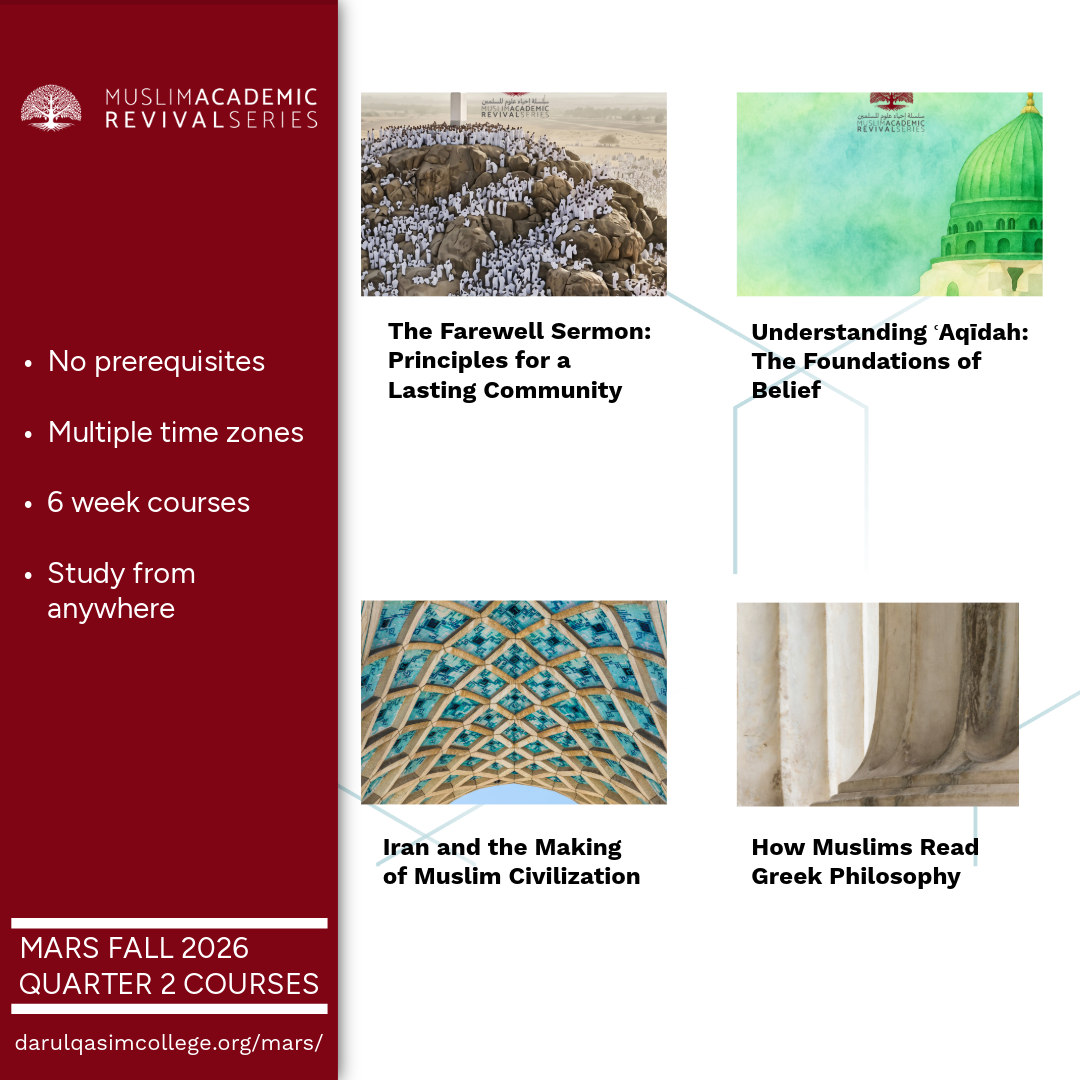
📚 Muslim Academic Revival Series (MARS) Spring 2026 Post-Ramadan Courses Are Now Open

MARS 102: Islamic Civilizational Values Through Hadith
MARS 103: Introduction to Fiqh
MARS 109: Palestine in the Islamic World

Designed for real life:
✅ No prerequisites
✅ No homework
✅ Flexible time slots

• Fully online and in English
• International student discount available
• Installment plans available

🗓 Registration Deadline: March 25, 2026

📢 What does Palestine look like beyond the headlines? 🍉

Dr. Firas Alkhateeb invites you to join MARS 109: Palestine in the Islamic World and rediscover the region’s rich scholarly and civilizational legacy from the first century after Hijra to the modern period.

At a time when Palestine is often framed only through modern politics, studying its history helps reconnect us with its deeper role in the Muslim world and challenges colonial narratives.

Mawlana Bilal Ali & Mawlana Asif invite you to join MARS 102: Islamic Civilizational Values Through Hadith and discover how the teachings of the Prophet ﷺ illuminate the ethical foundations of Islam.


Get Updates

* indicates required