August 14, 2026
Darul Qasim College graduates take Islamic scholarship beyond the walls of the classrooms in which they have studied. Under the training and leadership of Shaykh Amin Kholwadia, our ulema equip students with an academic understanding of Islam that informs their daily lives. Students are reminded of the importance of taking the knowledge they have acquired back to their communities with confidence, passion, and the courage to call towards truth and away from falsehood and sin.
We invite you to read this piece as an open call towards rectifying our actions on an individual and communal level.
بسم الله الرحمن الرحيم الحمد لله رب العالمين والصلاة والسلام على رسول الله وعلى آله وصحبه أجمعين
We are writing to advise Muslims of the greater Chicago area not to lend their attendance, their sponsorship, or their good name to events of the kind held last weekend under the name “Halalfest,” organized by “The Halal Group.” We object on two counts. The first is what this event did to the word “halal.” The second is what it did to the standing of Muslims among our neighbors. Both come from a single wrong: the event deceived the Muslims who came and disgraced the rest of us before our neighbors.
First: The word “halal” was used to market what is not halal.
To use the word “halal” is to pass a legal judgment upon an action — a claim that it is one that will not harm a person in the Hereafter. To distort that word and apply it to something haram is itself haram. It is deception and desecration. Allah Most High says, “Do not say about what your tongues
describe falsely, ‘This is halal and this is haram,’ fabricating falsehood against Allah. Surely, those who fabricate falsehood upon Allah do not succeed.” [al-Nahl 16:116] The claim that scholars are hopelessly divided on music obscures a broad and well-documented agreement. Across the Ḥanafī, Mālikī, Shāfiʿī, Ḥanbalī, and Salafī positions, stringed and wind instruments are prohibited by consensus, as are nearly all percussion instruments, with the duff at weddings a recognized exception (see Khalid
Baig, Slippery Stone: An Inquiry into Islam’s Stance on Music, ch. 10).
For anyone organizing an event for Muslims under the banner of “halal,” it is both incongruous and deceptive to make instrumental music a main attraction. Yet under the name “Halalfest” the organizers staged an entire musical concert last weekend. Their marketing boasted of “Live Musical Performances” and was decorated with musical notes for good measure. How heinous it is to call Muslims toward sin, and how much more heinous to do it under the banner of halal!
Every Muslim who attended on the strength of that word was deceived into sin by people they had no reason to distrust—a wrong the organizers perpetrated against every person in attendance. The scale of the affair compounds the matter. It is a settled principle that even lawful diversion becomes blameworthy through excess—a person who sinks great sums and long hours into entertainment has erred even when the entertainment itself is permitted. To do so when the entertainment is impermissible, importing performers to sing and dance on a public stage, is worse still.
Second: We were made a nuisance and cited for improper behavior in our own city.
The event drew municipal noise complaints for loud music played late into the night. Our 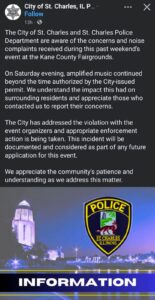 neighbors — people who did not attend, were not consulted, and are not Muslim — spent their evening disturbed by an event that billed itself as Islamic. The city of St. Charles now has reason to be wary of approving Muslim functions in the future. We are a community which needs tremendous social credibility in a country where many people know nothing of Islam except what they observe in Muslims. Our conduct is not a private affair.
When a public event advertised as “halal” draws negative attention, it is Muslims at large who are brought into disrepute — and to draw that attention over something as avoidable as a noise ordinance is a needless self-inflicted wound. There is no shortage of people actively seeking material with which to portray Muslims as inconsiderate, disorderly, and unfit neighbors. We are under no obligation to manufacture it for them, at our own expense, on a stage we built ourselves.
Muslims as a community–even students who organize MSAs, Muslim organizations that hold events, and masjids that organize public events-must ensure their attendees uphold exceptional Muslim civilizational conduct, especially if we are to minimize and eradicate Islamophobia in this country. The organizers of the “Halal” (haram) fest owe an apology to the residents and officials of St. Charles, IL, and to the Muslim community whose good name they have tarnished.
In closing
To the Muslims of this city: we advise you not to attend such events, not to sponsor them, and not to lend them your good name. Demand a higher standard from community organizers.
To the organizers: our objection is to the act, not to your persons, and our door is open. We advise you to retract the claim, make amends to the neighborhood you disturbed, and consult scholars before the next program. An open call to sin under the guise of halal, at the cost of our standing among our neighbors, is unwelcome in our communities and must not be tolerated.
We ask Allah to forgive us, the organizers, and all Muslims, and to rectify our actions.
We must stop using the word “halal” for events where haram is being practiced. We must display our best behavior among ourselves and in non-Muslim venues.