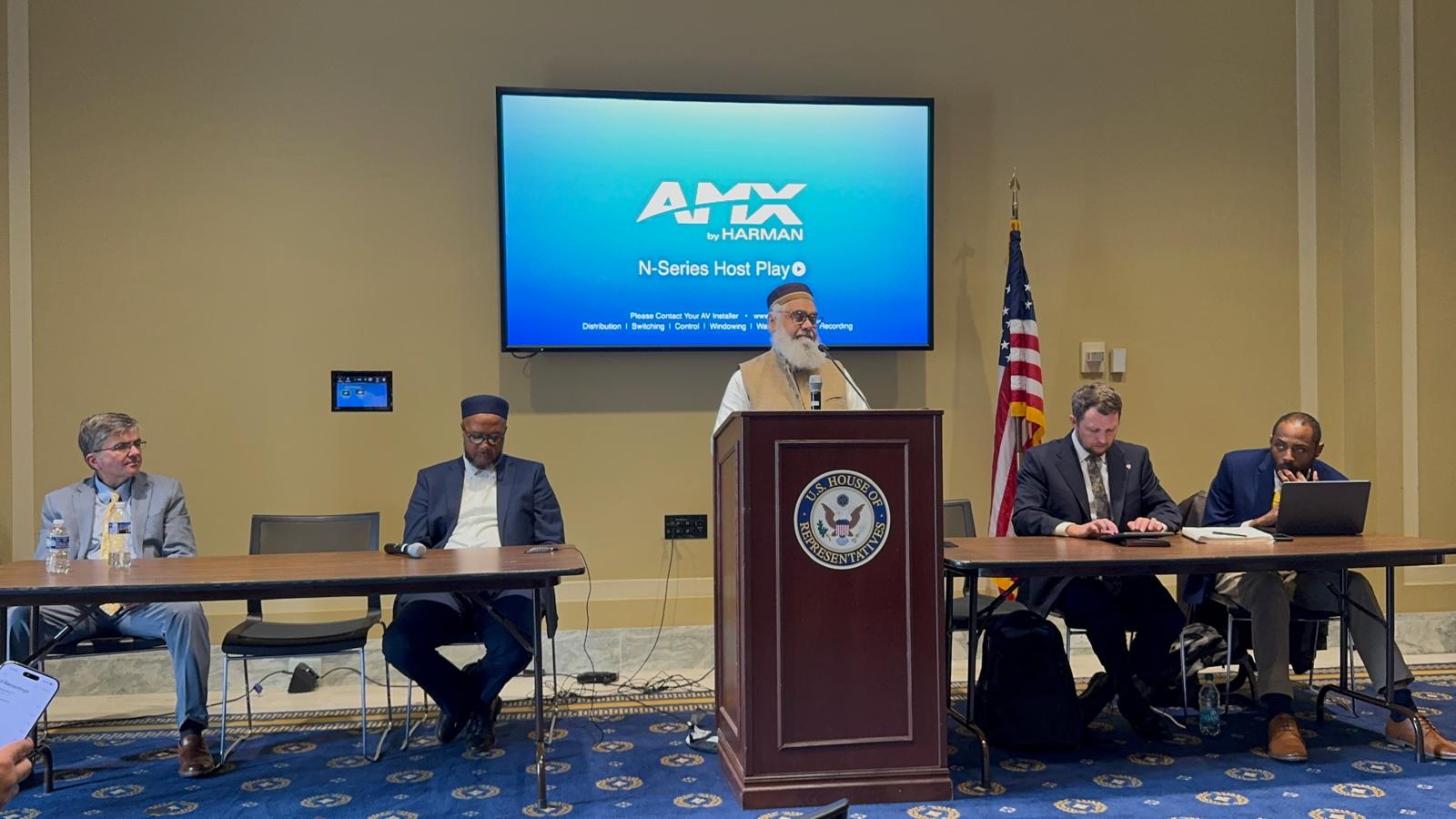
Editor’s Note: The following transcript is adapted from remarks delivered by Shaykh Mohammed Amin Kholwadia during a panel discussion held at the Rayburn House Office Building in Washington on June 23, 2026. The discussion focused on Islam, Sharia, and the U.S. Constitution, addressing common misconceptions about Islamic jurisprudence and the legal obligations of Muslims living in non-Muslim societies. This transcript has been lightly edited for clarity, grammar, and readability while preserving Shaykh Amin’s original words and meaning.
“The law of Sharia is that Muslims are not allowed to call for Sharia law in a non-Muslim country, by law.”
I am Mohammed Amin Kholwadia. I am the founder and president of a Muslim college which is licensed to offer master’s degrees in Islamic law and Islamic theology, situated in western suburbs of Chicago, Glen Ellyn, and we have quite a few students on our campuses. I’m also the president of Al Amin Ethics Institute, which advises Muslim professionals on ethics. I’m also now the founder of Darul Qasim Academy; it’s a Muslim girls’ high school. So now I have these institutions running side by side.
I am here today to talk about Islam and the U.S. Constitution. I’ll start by first of all introducing one or two theories that set the stage for your questions and answers later on.
“Every nation has the right to self-determination, to legislate its own laws without the interference of other countries.”
So, first thing is, I want to introduce the idea of self-determination for the sovereign state, which you all know is a very common theory. And all sovereign nations abide by it, and every nation has the right to self-determination, to legislate its own laws without the interference of other countries.
So, you know, England has its laws, and the UK has its laws, Canada has its laws, and India has its laws, and Saudi Arabia has its laws, and Pakistan has its laws. That’s called self-determination, and they have freedom to do that. And they have the prerogative to decide how they want to rule and govern their country. And no other country has any right to interfere with their law.
I dare say that this is observed by President George Washington. In the very early days of his presidency, George Washington and the early founders were very familiar with Islamic law. In fact, the first country to acknowledge and approve the U.S. as an independent country is Morocco. And George Washington wrote to the Ambassador of Morocco that if an American citizen is found guilty of a crime in Morocco, that citizen will be tried according to Moroccan law, and not according to American law.
“The early founders were very familiar with Islamic law.”
So, you see, immediately you have a sovereign nation, self-determination, community-based, because everybody values that. So, that’s the first thing.
So, the U.S. had good ties with Morocco, and even Jefferson and Lincoln. Lincoln had a great relationship with Muslim communities outside, and he praised one of the Muslim reformers and activists, Abdul Qadir. And they named a town in Iowa after him. It’s called Elkader, Iowa.
So, early ideas of this country were very familiar with Muslim theory, ideology, and politics. They were okay with it. There was no antagonism between the U.S. and other countries in the world. They were very supportive of each other. Jefferson, as you know, had his own version of the Quran, so he was very familiar with Islamic law and Islamic religion.
So, that’s the first point I’d like to introduce as a preamble to the second point.
“Most people don’t know this.”
The second point has to do with Sharia law itself. And I want you to listen to this very carefully, because most people don’t know this. And they go off on their rockers, disparaging and minimizing the importance of Sharia for Muslims.
Sharia is a code of religious practices that Muslims have to follow as part of their religion. That’s what Sharia is. And then Sharia law also. It’s the same thing.
So, according to us, we divide the Muslims into two camps.
Number one: Muslims who live in Muslim countries.
Number two: Muslims who live in non-Muslim countries.
“The laws are nuanced. They’re not the same.”
The laws are nuanced. They’re not the same.
So, that’s why you have to understand from a Muslim jurist perspective how we nuance the two laws. So, there’s a law for Muslims in a Muslim country, which is the total Sharia, and they have to abide by the total Sharia. And there’s a law for Muslims in a non-Muslim country, like the USA, and there the laws are slightly different.
The law of Sharia is that Muslims are not allowed to call for Sharia law in a non-Muslim country, by law. They’re not allowed to do this.
“There is no way that Sharia will allow a Muslim living in the USA to promote Sharia law in this country.”
There is no way that Sharia will allow a Muslim living in the USA to promote Sharia law in this country. It is not allowed by Sharia law.
But we must understand that the rule for engagement in a non-Muslim country for Muslims living in a non-Muslim country is that they must abide by the law of the land. That’s by Sharia law. Not by popular law, or what Muslim apologists might say. No. By Sharia law.
“Muslims must abide by the law of the land. That’s by Sharia law.”
I’m a Muslim jurist. I understand Islamic law. I know the nuance that Muslims abide by. So, no Muslim jurist in his right mind will ever tell his followers or congregation that you must abide by Sharia law in the USA. It’s not allowed. In fact, it’s a sin.
“It’s not allowed. In fact, it’s a sin.”
So, we believe that there is no question about whether Islam is compatible with the U.S. Constitution. We say that Muslims must follow the Constitution. And we do.
“Muslims must follow the Constitution. And we do.”
And the U.S., credit to the U.S. Constitution, allows freedom of religion. You have these amendments to the U.S. Constitution that allow for freedom of religion, and that’s all we ask for.
“That’s all we ask for: freedom of religion.”
We don’t ask for the U.S. to change the laws according to the Muslim mindset, or the Muslim psyche. We say we’ll abide by the laws of this country.
The only thing is that we will not tell Muslims to commit a sin. So, if there’s a law that allows a sin, we will say to Muslims, “you can’t do that.”
Like alcohol. Drinking alcohol. Very good example. You are allowed to drink some alcohol in this country. But Muslims aren’t allowed. Not because it’s illegal, but because it’s a sin.
“There’s a difference between a sin and something that’s legal or illegal.”
So, there’s a difference between a sin and something that’s legal or illegal. We make that nuance all the time, every day.
A Muslim in this country is going to abstain from sin. Whether that’s legal or not, we will not call for the U.S. to change the law of the land, and abolish alcohol and say, “make drinking alcohol illegal.” We won’t do that.
“But, that’s what Sharia law is.”
But that Sharia law is for a Muslim country. It is not for a non-Muslim country.
“There is no fear, there is no threat.”
So, there is no fear, there is no threat, because we’ve never said that in our jurisprudence. It’s very clearly written in the primary sources of Islamic law. Not secondary or tertiary sources.
The primary sources of Islamic law, which are the Qur’an and the statements of the Prophet Muhammad ﷺ, clearly say that Islamic law, Sharia law, is for Muslims in a Muslim country. It is not for Muslims in a non-Muslim country.
That, you must respect.
“There is no contradiction between Sharia and the U.S. Constitution.”
Because once you’ve understood this, there is no question. This conference is redundant, because in terms of jurisprudence and even theologically, we’ve never seen a contradiction between Sharia and the U.S. Constitution.
Because we tell our congregation. It’s even on our website, Darul Qasim website. If you go to www.darulqasim.org, on the website, you will see this clearly stated and written: “you must follow the law of the land.”
So, there is no contradiction. We’re okay. That’s why we live peacefully in this country.
“You must follow the law of the land.”
So, these are the two things I’d like to bring forward, so that as the debate goes on, we look forward to your contributions, and to your questions and answers.
Thank you very much.
Listen to the audio here: www.youtube.com/watch?v=7hsD16ZwnOM